Quarterly insights · Q2 2026
The quarter in legal AI: April to June 2026
Capability kept moving. The measuring, governing and accounting for it did not. Four arguments from the quarter in which that gap started producing consequences with dates attached.
This is a designed working preview of the Q2 report. Peter has not yet reviewed the joint byline, and the article remains excluded from search indexing until that editorial gate is complete.
The TITANS view
This quarter, the technology continued to progress and largely kept its promises on delivery, while the infrastructure around it began to show gaps. A frontier model was released, topped the legal benchmarks and was then switched off worldwide by the US government. Two of the largest firms in the world committed to building their own platforms, while the technology companies behind the models moved directly into their customers' organisations. Adoption passed 90% in one survey, while another found that a third of firms could not show their most important client the impact of their AI adoption.
Hallucinated material continued to reach courtrooms, including from enterprise-grade tools. The capability is there. What is struggling to keep up is the measurement of its impact, the governance around its use and the allocation of accountability. The consequences of those gaps are now starting to come through.
Data insights
Numbers that moved.
Using our internal statistics database, which powers The Signal, we looked at the numbers that changed over the period. Several figures are vendor-commissioned or self-reported. The source and sample sit with each number so that caveat stays visible.
87.9%
Of the same respondents, the share saying their workload increased after adopting AI.
Ironclad, May 202632%
Firms unable to demonstrate AI value confidently to their most important client.
Litera, Spring 202640% to 15%
UK executives expecting entry-level hiring demand to rise, 2024 against 2026.
Accenture, April 2026$11.5bn
Committed to two enterprise AI services ventures announced on 4 May.
Anthropic and OpenAI ventures4%
General counsel reporting a direct benefit from providers' use of AI, against 78% wanting cost reduction.
Deloitte Legal, n=121Nobody stayed in their lane
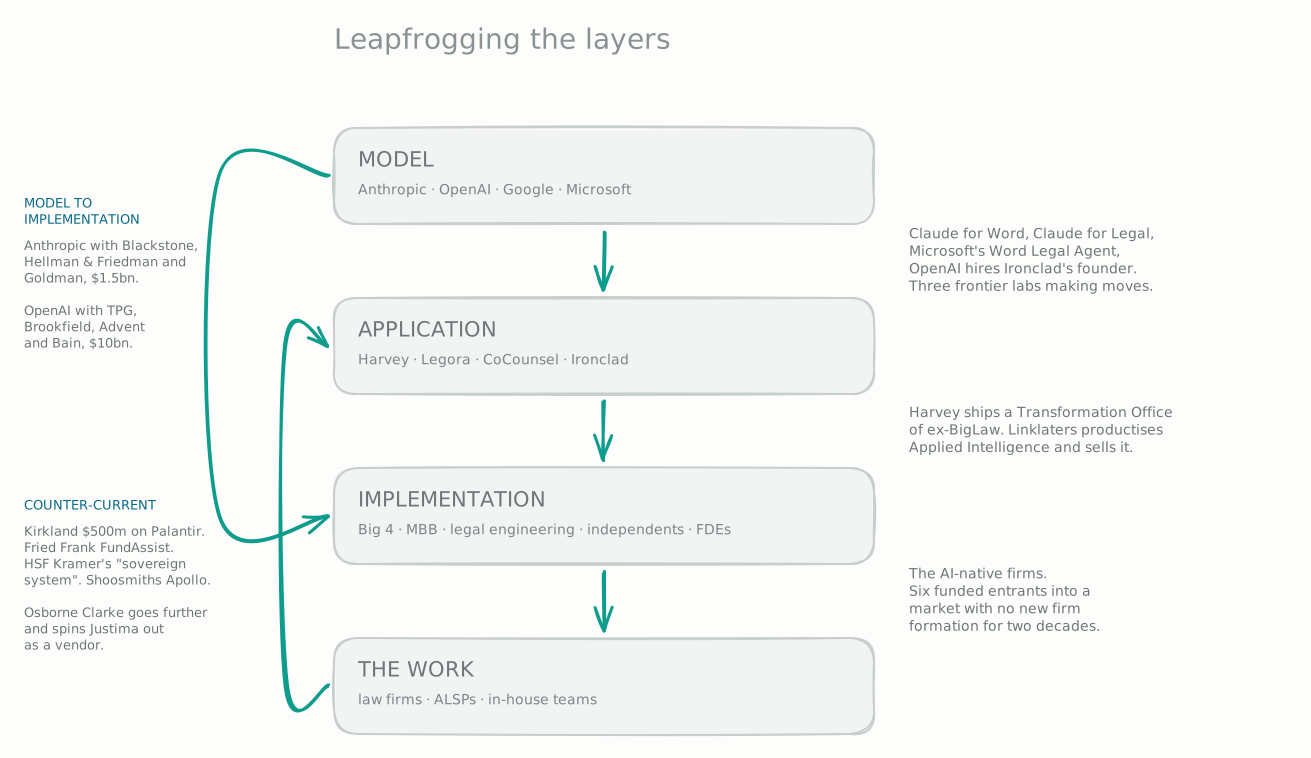
One of the structural stories of this quarter is that each layer of the legal AI market jumped into the next.
Anthropic went from being the model behind other people's products to being discussed as a legal technology company. The release of Claude for Legal, with its connectors, practice-area plugins and growing list of agents, gathered a great deal of interest and started that conversation. Microsoft also shipped its own Word Legal Agent for Copilot Frontier customers. OpenAI brought in Ironclad's founder to establish a similar legal vertical. All three frontier labs named a legal offering within the quarter.
Both Anthropic and OpenAI also announced enterprise AI services ventures. Anthropic's $1.5bn venture is backed by Blackstone, Hellman & Friedman and Goldman Sachs. OpenAI's $10bn venture is anchored by TPG with Brookfield, Advent and Bain. Both will place forward-deployed engineers inside client organisations to redesign work around the model, potentially leapfrogging the application layer.
That move recognises that the technology is not enough. Driving adoption and embedding the technology into real work product is the hard part. The pitch across the market is starting to change from what the technology can do to a more practical question: can you make this work within our organisation? Law firms especially are now being asked to show the results of their work.
Going the other way, a cohort of AI-native firms moved into delivering legal services themselves: Carta Law through its acquisition of Avantia, Moritz, Talairis, LawFairy, Manifest OS, Keith, Enter and Superlegal. Several well-funded entrants are moving into a market where very little new commercial firm formation has happened over the past two decades. At the same time, large law firms including Kirkland, Fried Frank, HSF Kramer, Shoosmiths and Osborne Clarke are committing funds and building their own solutions.
If you sell an application built on a frontier model and the company supplying that model is now selling to your customers, what reason does it have to preserve the same relationship and give you its latest models immediately? There may come a point when earlier access becomes a competitive advantage for the frontier labs themselves, rather than something they pass straight through to their competitors.
It becomes a different market when your supplier is competing for the same customers. And the quarter demonstrated a second dependency that has nothing to do with competition: for nineteen days the model at the top of the legal benchmarks was unavailable to every firm and vendor built on it, by government directive, for reasons none of them could influence or predict. Whatever the outage says about policy, it says something simpler about supply: access to a frontier model can be withdrawn overnight, and no contract with the lab changes that.
We are already seeing a response. Harvey is looking at post-training open-weight models on individual firms' processes, reducing its reliance on frontier models by routing to them only where needed. Thomson Reuters is building its own model, and Kirkland has hinted at fine-tuning open weights into a firm-owned model. The release of GLM 5.2, and the quality available under a permissive licence, has turned this from an aspiration into a genuine option. The strategy could be to own the weights, reduce dependence on frontier providers and still remain close to the cutting edge.
Underneath all of this is the same race: can law firms change their business model quickly enough before somebody else, with enough capability and attention, forces that change on them? The AI-native firms are betting that they can reach critical mass faster than the incumbents can move. The incumbents' response this quarter has been defensive, and nobody is losing market share quickly. Legal is a slow-moving market, but the contest is now open.
Sold by the hour, billed by the token
Legal was second in enterprise AI spend across the whole economy and last on Bain's pilot-to-production funnel.
Per-token prices fell while the work became more token-intensive, so per-matter cost climbed and became less predictable. Legora signalled a move away from seats when it put its heaviest agentic tier on consumption pricing on 23 June, billing for outputs and usage attributable to the matter. Harvey looked inwards at how to reduce its own costs. Thomson Reuters' research estimated $143bn of US client revenue at risk from the implementation gap, with 78% of corporate clients calling AI quality gains essential and only 6% saying providers deliver them.
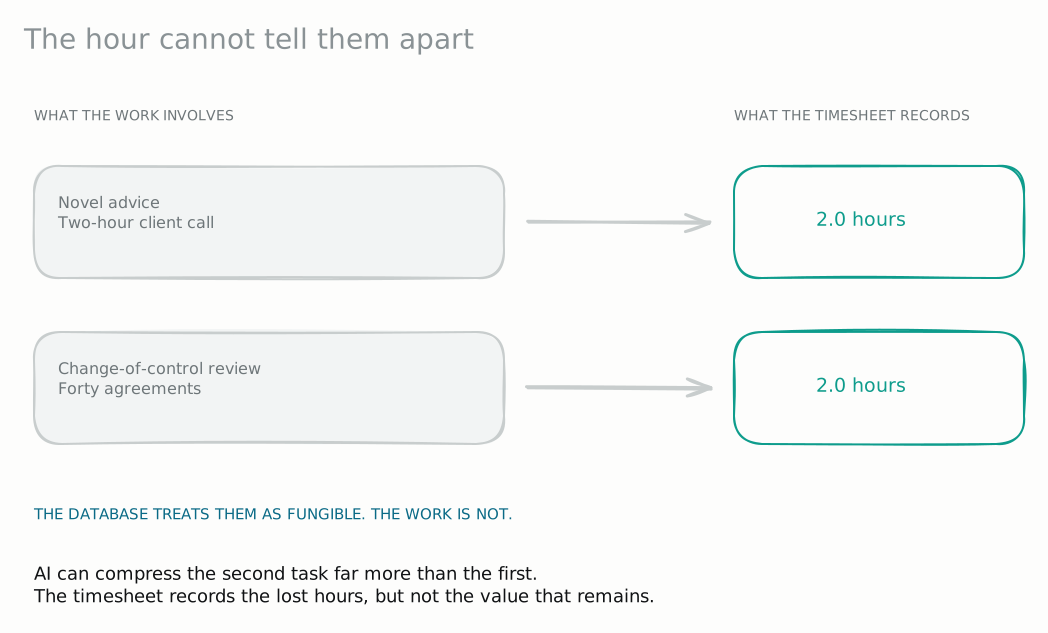
A core reason these questions are difficult to settle is that the profession has no unit to settle them in. Legal work is measured by time, not output. An associate spending two hours on a call working through a novel piece of advice and the same associate spending two hours reviewing forty agreements for a change of control produce identical measures in a database. The database treats those hours as fungible. The work is not. That matters less while effort and output move together.
AI is now breaking that relationship, and not evenly. It can reduce the second task substantially and barely touch the first. The hours most likely to disappear are the highest-volume and most repeatable, even where they represent only a small part of the genuine value delivered. We have never recorded which hours required the knowledge, judgement, intensity and client relationship that the client was actually paying for. The timesheet flattens them into one number and destroys the evidence a firm needs to defend the value of its work when clients ask for a different price. What remains is anecdote.
This is why the argument about whether AI makes legal services cheaper or improves firm margins cannot be answered at market level. It depends on the category of work. The most repeatable work can be delivered much faster, but it is also the work clients are least willing to keep paying for. Its price is likely to fall. Work built on judgement, knowledge and the client relationship may become somewhat more efficient, but not to the same extent. Its margin can improve and its price may even rise if the value is visible.
The client side is not waiting for the answer. Deloitte found 78% of general counsel naming cost reduction as the main benefit they want from their providers' use of AI, and 4% saying they have directly experienced any. When we speak to in-house teams, the focus is consistently on reducing legal spend and outside counsel fees, through both insourcing and direct fee reduction. A lack of transparency about the work sitting underneath the bill has created distrust, and AI is making that incentive gap more visible. The only credible way to close it is transparency, evidence, reporting and better control over the work being delivered and its value to the client.
You can't automate liability
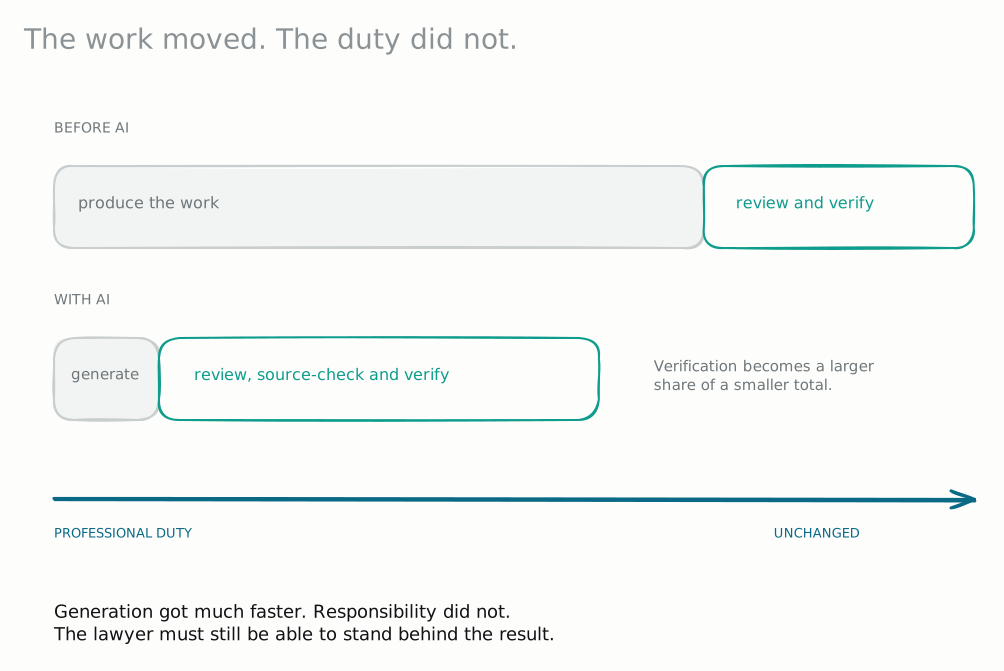
Lawyers have always been responsible for the accuracy of their work, for the sources on which they rely and for ensuring that false citations, fabricated cases and invented legal references do not reach a client or a court. Using technology to produce part of the work does not change that expectation.
Sir Colin Birss, Chancellor of the High Court, told the City of London Law Society on 22 April that confidentiality is a precondition of privilege and public AI use breaches it. It was a clear statement that consumer tools sit outside the perimeter of protection for legal advice. The California State Bar proposed requiring lawyers to verify every AI output, with no carve-out for low-stakes work. New York's system-wide rule took effect on 1 June and Florida's certification requirement on 15 June. The Ninth Circuit handed down the first federal appellate AI sanctions order on 3 June, holding that the violation lands at signing and filing rather than at the point of using AI. The SRA rewrote its supervision guidance and addressed delegation to AI systems for the first time.
In May, the High Court admonished a major UK firm after a junior used the firm's own enterprise tool to put a fabricated insolvency rule before the court twice. It is the first reported English case in which a firm-procured, enterprise-grade platform produced the hallucination. It is unlikely to be the first time an enterprise tool has produced an error that reached legal work. Disputes surface these errors first because the work is more likely to come before a judge and enter the record. Errors in transactional or advisory work may never receive the same scrutiny.
Procurement matters, but this remains principally a training and responsibility problem. The duty of care does not transfer because the tool is expensive, enterprise-grade or good most of the time. More people are using these systems, access is easier and the output is increasingly convincing. A member of the public can receive an answer from a consumer tool that looks useful and confident enough to be acted on. A professional can provide detailed instructions and matter context and receive valuable analysis, but the system may still miss the wider problem, lack access to the right sources, overlook work already completed or answer a subtly different question from the one asked.
That combination produces more errors, and more opportunities for those errors to enter the record. It is especially risky where pressure to raise adoption, measure individual usage and demonstrate a return on investment arrives before training and verification habits are established. For many lawyers, engagement with a new tool is fragile. A failed first experience can make it difficult to bring them back. Firms that started more slowly, limited access and put training around the tools may ultimately have built the stronger foundation.
Verification needs to be taught as a core skill for using AI in legal work, not added as a warning at the end of the training. It is also easy to resent. If a tool produces in one minute what previously took two hours, spending an hour checking work you did not write feels like giving the gain back. Where the output is right most of the time, verification means reading a large amount of good material while remaining alert to the small error whose location you do not know. It is tiring and it takes practice. We would rather be fifty per cent faster, right and able to stand behind the work than ninety-nine per cent faster and possibly wrong. Saving time is real, but so is the time required to provide good inputs, establish the right sources and verify the result. That is the standard the work requires.
Average was never the goal
Accenture's UK research in April found that executives expecting entry-level demand to rise fell from 40% in 2024 to 15% in 2026, while those expecting it to fall rose from 22% to 37%. AI is unlikely to be the only cause. Economic conditions and geopolitical uncertainty also affect hiring. It is nevertheless consistent with a wider concern about what happens to junior roles as AI becomes more capable.
The concern is usually that juniors will not learn, and the risk of cognitive degradation from handing work to AI is real. It is particularly difficult in law because the profession has never had a consistently robust and intentional training system. It hires clever people, puts them through a great deal of work and relies on exposure, supervision and the structure of the firm to sort those who develop into more senior roles.
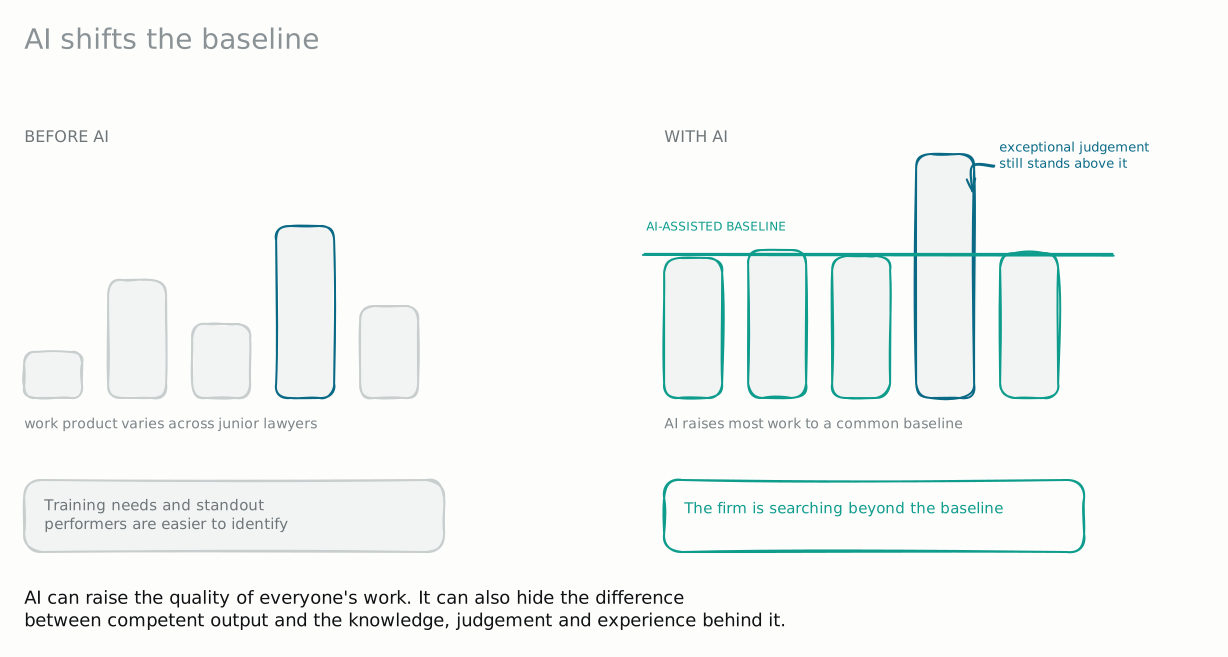
AI can improve that system. It can bring knowledge into a task that a trainee or junior lawyer would not previously have had and help more people reach competent work more quickly. It raises the baseline. But a shortcut can produce the work without building the ability, and people who can deliver an average output without developing the knowledge underneath it will eventually reach a ceiling. The output can look the same while the capability behind it is very different. That makes gaps in training harder to spot and makes it harder to identify the people who are genuinely exceptional.
The baseline is not the goal. Firms still need people who can go beyond it, and those people need deliberate investment. Time saved on producing work should create more time for one-to-one supervision, knowledge-sharing and the transfer of experience from senior lawyers. Some of the most experienced partners will leave the profession over the next few years. AI creates an opportunity for them to pass more of what they know both to junior lawyers and into the firm's systems, but only if the time is intentionally used that way.
The delegation problem sits underneath it. If the cognitive load is handed over too early, people learn to operate the tool without learning to judge what it returns. Judgement comes from subject knowledge, close analysis and experience. Without that foundation, the human in the loop becomes a rubber stamp and a person to blame rather than a genuine control. Ethan Mollick, who made the case for humans and AI as collaborators, changed his framing in June towards supervising AI: deciding when to refuse its help and when to let it perform the task entirely.
The work AI removes first is often the lowest-judgement, highest-volume work, but it is also where people learned. Replacing that learning with intentional training and knowledge transfer affects the leverage model, the margin conversation and the time supervisors must spend with their teams. The baseline will rise for everyone. The question is whether firms can still develop, recognise and reward the people who rise above it.
On the horizon
Whether application providers continue to receive early access to frontier models. Day-one parity matters, but prior access matters more. Vendors need time to test, integrate and build around a model if they are to launch alongside the frontier labs. If the labs keep their best models or earliest access long enough to give their own products an advantage, the supplier relationship has materially changed.
Whether owning weights works. Harvey, Thomson Reuters and at least one firm are building towards it. Proof-of-concepts still sitting at proof-of-concept at the end of Q4, products that do not launch, or frontier models continuing to outperform open-weight alternatives on release would all point to the same answer.
Whether metered pricing changes behaviour before it changes price. The thing to watch is not headline cost but exploratory use, which is where competence with a platform is built and the first thing a meter suppresses. Firms introducing approval steps or caps on agentic runs would settle it: that is the meter changing behaviour before it has changed any price.
Whether anybody publishes an outcome. Adoption data publishes constantly. Twelve months of client-facing AI deployment has produced almost no published evidence of what any of it achieved. One credible outcome study would move this whole argument, and it is the single most useful thing anyone in this market could do.
Whether OpenAI launches a named legal product. The appointment of Ironclad's founder to build a legal vertical established the intent. A ChatGPT for Legal, or another named legal offering, would put all three frontier labs directly into the market and make the competition with their application-layer customers explicit.
Book-markables
Stanford Digital Economy Lab
The Enterprise AI Playbook
Fifty-one successful deployments, deliberately studying what worked. Its conclusion is that the organisation, not the model, separated production from another pilot.
Ethan Mollick
Co-Existence and the End of Co-Intelligence
The author of the collaboration framing retires it in public and asks the harder question: when should we refuse the help, and when should we hand over the keys?
Bednar, Cleveland, Erbsen and Schwarcz, University of Minnesota
Artificial Intelligence and Human Legal Reasoning
A preregistered randomised trial of what happens to legal reasoning after the AI is taken away. The only study of its kind in the quarter.
Microsoft Research
New Future of Work Report 2025
Forty to sixty minutes a day saved, while 40% of users received polished, useless output from colleagues in the same month.
Jack Clark on The Rest Is Politics: Leading
Is It Already Too Late to Control AI?
An hour with Anthropic's policy chief, days before his own government pulled the company's best model off the market.
SemiAnalysis
AI Dark Output
Why a real productivity revolution can look like a bubble when the costs are visible and the output is not.
Pope Leo XIV
Magnifica Humanitas
The first papal encyclical written wholly about AI treats it as a question of power: monopolies, asymmetry, data as a common good, and disarmament as a deliberate counter-frame to alignment.
Source notes
The data cards link to their underlying publications. Key regulatory sources include the Chancellor of the High Court's speech on privilege, the Ninth Circuit sanctions order, New York's statewide rule, Florida's certification requirement and California's proposed ethics changes.
Continue reading